
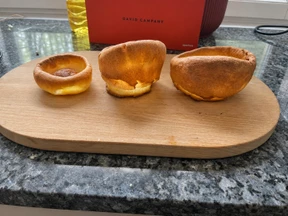
Posted by Mia Wren on 4th Nov 2026
How to Make Big Yorkshire Puddings (and Which Tin to Use)
Header picture: illustration.
Who in your house asks for the biggest Yorkshire pudding on the plate? At Christmas it is usually everyone. Big Yorkshires look generous and hold a lot of gravy, but they are also the ones most likely to come out flat, pale underneath or still wet in the middle. The good news is that most of that comes down to three things: the tin, how much batter goes in, and how long you leave the oven door shut.
Here is how we would go about it, from choosing the tin to timing them around the turkey.
What "big" actually means
When people search for a large Yorkshire pudding tray, they usually mean one of three things:
- Big individual puddings, one per person, about the size of a saucer once risen. These come from a four-hole tray.
- Deep, tall puddings with high sides and a deep well. These come from deeper cups, such as a jumbo muffin tray.
- One giant pudding cut into wedges, made in a roasting tin.
Each works. They just need slightly different handling, so decide which one you are after before you start.
The tin matters more than the recipe
A Yorkshire pudding rises because cold batter hits very hot fat and turns to steam fast. The tin's job is to hold that heat while the batter goes in. A thin tin loses heat the moment the batter lands, and a big pudding needs more heat than a small one to set its sides before it collapses. That is why heavy carbon steel suits big Yorkshires: it stays hot through the pour. For more on why material matters, see our guide to choosing a Yorkshire pudding tin.
Our three options, by the size of pudding you want:
- 4 Cup Yorkshire Pudding Tray: cups 10cm across and 1.3cm deep. This is the classic big individual Yorkshire. The shallow cup gives a crisp rim and an open middle for gravy. If you are feeding six or eight on Christmas Day, the set of two gives you eight big puddings in one go.
- 6 Cup Jumbo Muffin Tray: cups 10cm across and much deeper. You get taller, thicker puddings with a deep well, a little softer in the base. Good if your family likes them more bready than crisp.
- 12 Cup Yorkshire Pudding Tin: 7cm cups, 2cm deep. Not a big Yorkshire tin, but worth knowing about if you want a second batch of small ones for the children's plates.
We do not make a roasting tin, so for one giant pudding use the heaviest metal roasting tin you have. Avoid glass and ceramic for this: they take longer to heat and the base tends to stay soft. You can see all of our Yorkshire pudding tins in one place.
How much batter for big Yorkshires
The batter itself does not change for big puddings. Equal volumes of egg, plain flour and milk is the ratio most people swear by, and our guide to Yorkshire pudding batter ratios goes into why. What changes is how much goes in each cup.
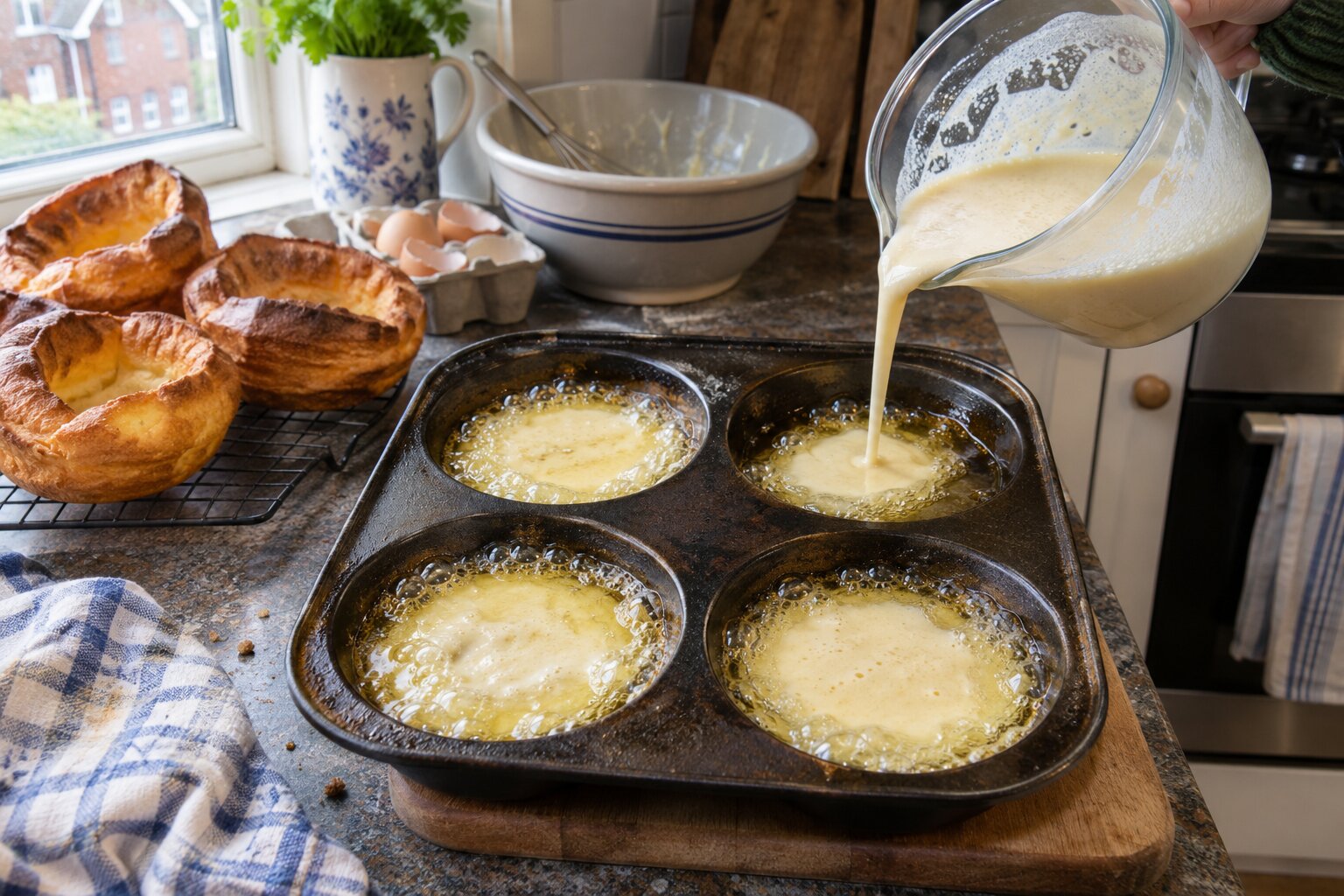
- Fill about halfway. This is the biggest single fix. An overfilled cup is heavy in the middle, and the middle is the last part to set. Half full leaves room to climb.
- As a rough guide, four medium eggs make enough batter for a four-hole tray filled halfway, with a little left over. For a set of two trays or a jumbo tray, use six eggs. Measure the eggs in a jug, then match the flour and milk to the same line.
- Rest the batter for at least 30 minutes, or make it in the morning and keep it in the fridge. Give it a stir and let it come back towards room temperature while the oven heats.
Fat and heat
Big puddings need the fat hotter than you think. A tablespoon in each cup of a four-hole tray is about right: enough to cover the base well. Use a fat with a high smoke point, such as beef dripping, lard or sunflower oil. Our post on the best oil for Yorkshire puddings compares them.
Heat the tray with the fat in it at 220°C (200°C fan) for at least 10 minutes, until the fat is shimmering. Then work quickly: tray out, batter in, tray back, door shut.
How to make big Yorkshire puddings
- Make the batter: Whisk equal volumes of egg, plain flour and milk with a pinch of salt until smooth. Rest it for at least 30 minutes.
- Heat the fat: Put a tablespoon of fat in each cup of a four-hole tray, or a shallow layer in a roasting tin. Heat at 220°C (200°C fan) for at least 10 minutes.
- Pour fast: Take the tray out, close the oven door, and fill each cup about halfway. The batter should sizzle as it goes in.
- Leave the door shut: Bake for 20 minutes without opening the oven. Opening it early lets the steam out and the sides fall.
- Finish the base: Check at 20 to 25 minutes for a four-hole tray, 25 to 30 for jumbo cups, and 30 to 35 for one giant pudding. If the rims are brown but the middle still looks wet, turn the oven down to 190°C (170°C fan) and give them five more minutes.
- Serve straight away: Big puddings soften quickly as they cool, so bring them to the table last.
Why big ones go wrong
Most big Yorkshire failures fall into three groups.
Flat or dense. The fat was not hot enough, or the tray sat out of the oven too long while you poured. Our post on why Yorkshire puddings don't rise works through the other causes.
Sunk in the middle. Usually the cup was too full, the door was opened early, or they came out before the base had set. A risen pudding that drops as soon as it leaves the oven needs a few more minutes, not a new recipe.
Stuck to the tin. Not enough fat in the cup, or fat that was not hot when the batter went in. Our guide to stopping Yorkshire puddings sticking covers it in detail.
Fitting them around Christmas dinner
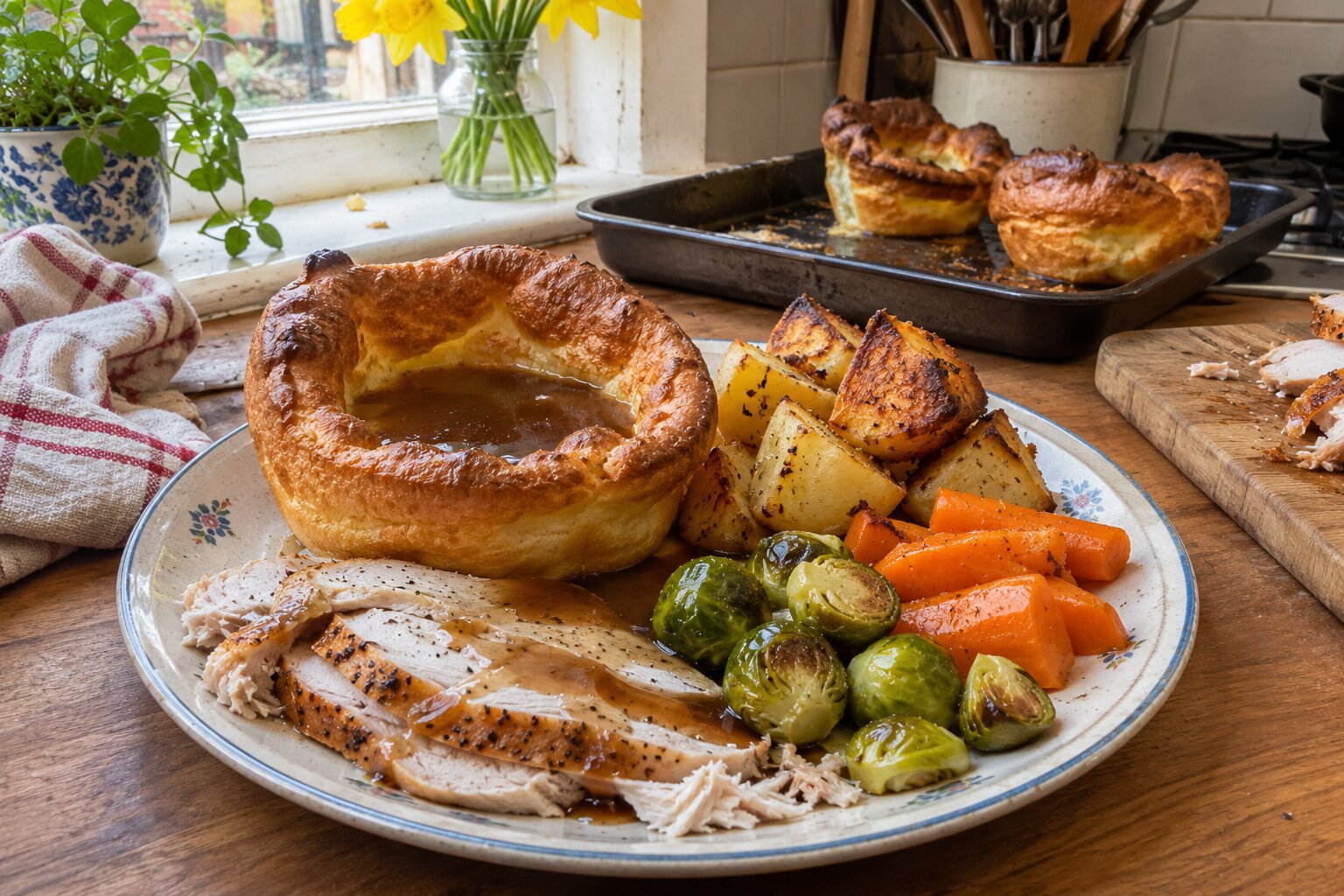
The turkey is the problem. It takes the oven for hours, and Yorkshires need it at full heat. The window that works for most kitchens is when the turkey comes out to rest. It needs at least 30 minutes under foil anyway, which is exactly how long the oven needs to heat the fat and bake the puddings.
If you have two ovens, or you would rather not be pouring batter at that point, make them earlier and reheat. Bake them fully, cool them on a rack, and reheat at 220°C for a few minutes just before serving. Our complete guide to tall Yorkshire puddings has more on making them ahead.
Wrenbury tins are heavy-gauge carbon steel, and every one carries a 10-year guarantee. Hand wash and dry the tray straight away after the big day, and it will be ready for the next roast.

4 Cup Non-Stick Yorkshire Pudding Tray
£18.99
Four 10cm cups, 1.3cm deep, for big individual Yorkshires.
View product
4 Cup Non-Stick Yorkshire Pudding Tray Set of 2
£29.99
Eight big Yorkshires in one bake, for Christmas Day numbers.
View product
Non-Stick 6 Cup Large Jumbo Muffin Pan Tray
£21.99
Six deep 10cm cups for tall Yorkshires with a deep well.
View productFrequently asked questions
Why do my big Yorkshire puddings sink in the middle?
Usually the cup was too full or the oven door was opened before the sides had set. Fill each cup about halfway, keep the door shut for the first 20 minutes, and give them a few extra minutes if the base still looks wet. A pudding that comes out a little early will rise in the oven and drop on the plate.
Why is the bottom of my large Yorkshire pudding soggy?
The base is the last part to cook, and big puddings have more of it. Make sure the fat is shimmering before the batter goes in, and use a metal tin rather than glass or ceramic. If the rims are brown before the base is done, lower the oven to 190°C (170°C fan) for the last five minutes.
Can I use a muffin tin for big Yorkshire puddings?
Yes, but a deep muffin cup gives a taller, softer pudding than a shallow Yorkshire cup. A jumbo muffin tray with 10cm cups makes a big, deep Yorkshire. A standard 12-cup muffin tray makes small ones. For the classic wide, crisp shape, a shallow four-hole tray is the better tin.
Can I make big Yorkshire puddings the day before Christmas?
Yes. Bake them fully, cool them on a rack and keep them in an airtight tin, or freeze them. Reheat at 220°C for a few minutes until crisp again. Avoid the microwave, which makes them chewy.
How long do big Yorkshire puddings take to cook?
About 20 to 25 minutes in a four-hole tray at 220°C (200°C fan), 25 to 30 minutes in deep jumbo cups, and 30 to 35 minutes for one giant pudding in a roasting tin. Judge by colour and a firm, dry rim rather than the clock.
The short version
Hot metal tin, shimmering fat, cups half full, door shut for 20 minutes. Do those four things and big Yorkshires are no harder than small ones.