
Posted by Mia Wren on 22nd Jan 2026
Crumpet Rings Guide: Taller, Fluffier Crumpets Every Time
Tall, hole-filled, butter-soaking crumpets are not luck — they're four variables done right: batter consistency, pan heat, how much you pour, and how long you wait. This guide walks through each one, then fixes the failures everyone hits the first time.
What makes a crumpet a crumpet (and not a pancake)
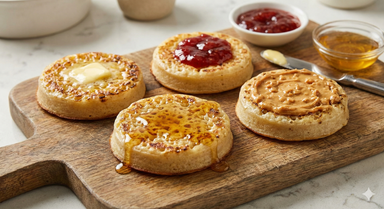
A proper crumpet has a soft, spongy inside, a set top full of holes, and a base that crisps when toasted. The holes are the whole point — they're what carry the butter down instead of letting it sit on top.
The ring matters because crumpet batter is loose and pourable. Without containment it spreads into a thin pikelet instead of rising into a thick round. If you're fuzzy on where a crumpet ends and its lookalikes begin, we've settled crumpets vs English muffins and crumpets vs bread separately.
How to cook crumpets in rings, step by step
- Set the pan to medium-low and preheat the rings: lightly oil the pan and the inside of each ring, then sit the empty rings on the pan for a minute or two before filling. Too hot and the base cooks before the top sets; too cool and the bubbles never come. Cold rings give you uneven sides, and a warm pan is also what stops batter leaking underneath.
- Get the batter to thick-cream consistency: it should pour easily but still have body — think double cream, not pancake batter. This is the single biggest make-or-break factor. If your last batch had no holes, the batter was almost certainly too thick: thin it with liquid one tablespoon at a time until it flows smoothly.
- Fill each ring about halfway — roughly 100ml in a 9cm ring: the batter needs headroom to rise to the rim. Overfill and you get a raw top and batter climbing the ring; underfill and the crumpet comes out thin, with less sponge for the butter.
- Cook low and slow for 6–10 minutes: small bubbles appear, grow and pop; the surface gradually turns set and matte; the bubbling slows. That's the sequence you're watching for. If a few large bubbles stall without popping, a gentle prod with a skewer helps the surface set evenly. This is not a fast cook — patience is the recipe.
- Lift the rings only when the top has set: the rings will be hot, so use tongs or a cloth. Most tearing happens because the ring came off too early — if it resists, run a thin knife around the inside edge first, then lift.
- Toast to finish: traditional crumpets are griddle-cooked, then toasted. Toasting crisps the base, opens the holes and makes the butter melt into the crumpet rather than sitting on it. A crumpet that looks pale and soft straight off the pan is normal — the toaster is the finish, not a rescue.
Common problems and fast fixes
Not enough holes. Batter too thick is the usual culprit — thin it a tablespoon of liquid at a time. If the batter's right, the heat is too high and the top is setting before the bubbles get through.
Sticking to the rings. Oil the inside wall of each ring, not just the pan, and give the crumpet longer before lifting — a set top releases; a wet one tears. If rings that used to release have started grabbing, wash them properly to shift built-up oil residue rather than adding more oil.
Gummy or wet top. Heat too high, cook too short, or ring too full. Drop the heat, give it the full 10 minutes, and fill to halfway only.
Flat crumpets. Rings weren't preheated, the batter went in too thin, or the yeast was tired. And check the pan itself — a warped pan means the ring never sits flush, which costs you height and leaks batter. If your pans are part of the problem, our guide to bakeware that doesn't warp explains what to look for.

Non-Stick Crumpet Rings Set of 4 — Made in England
£17.99
Four sturdy 9cm carbon steel rings made in England, PFOA-free non-stick, hob or oven. 10-year guarantee.
View product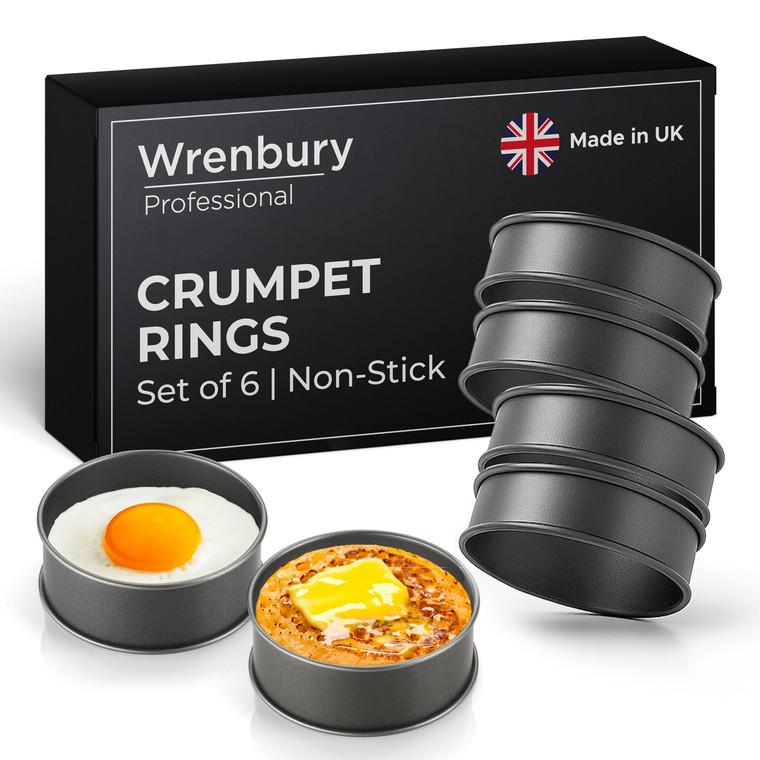
Non-Stick Crumpet Rings Set of 6
£19.99
Six rings, one pan, a whole batch at once — batter doesn't wait politely for round two. PFOA-free non-stick. 10-year guarantee.
View productCleaning and care
Let the rings cool a little, then soak them in warm soapy water for 10–15 minutes — soaking straight after cooking prevents almost all buildup. A soft sponge does the rest; skip the metal scourer. Dry them thoroughly with a tea towel before they go back in the drawer, because carbon steel left wet is carbon steel that rusts. The same routine applies to everything in the range — it's all in our care and use guide, and it's how a 10-year guarantee stays a formality rather than a claim form.
Beyond crumpets
The rings earn their drawer space well past crumpet season: neat fried eggs that sit flush on a muffin, clean-edged mini pancakes, rosti nests, rice and grain stacks for plating. We've written up five ways to use crumpet rings beyond crumpets with the technique for each, and the rings sit alongside the rest of our crumpet rings collection.
Frequently asked questions
Why don't my crumpets have holes?
The batter is too thick, nine times out of ten. It should pour like thick cream — thin it one tablespoon of liquid at a time until it flows smoothly into the ring. The other causes: heat too high (the top sets before the bubbles arrive) or tired yeast that never produced the bubbles in the first place. Fresh yeast, looser batter, lower heat — in that order.
Do you flip crumpets?
Traditionally, no — a crumpet cooks on one side so the top stays soft and open. Once the surface has set and you've lifted the ring, you can flip it for under a minute if you want the top lightly coloured, but any longer flattens the holes you worked for. The real finishing step is the toaster, not the flip.
Why is the middle of my crumpet gummy?
Too much batter, too much heat, or not enough time. A ring filled past halfway can't cook through before the base overdoes; high heat sets the outside while the middle stays wet. Fill to about halfway (roughly 100ml in a 9cm ring), keep the heat at medium-low, and let it take the full 6–10 minutes.
Can I make crumpets without rings?
Not really — you can cook the batter freeform, but it spreads into a thin pikelet rather than a tall crumpet. The ring is what holds the loose batter while it rises and sets. Improvised substitutes like cutter rings tend to be too shallow and too sharp-edged to release cleanly; a purpose-made non-stick crumpet ring is 3cm deep for exactly this reason.
Can you freeze homemade crumpets?
Yes, and they freeze well. Cool them completely, freeze flat in a bag, and toast straight from frozen — the toasting step they'd get anyway doubles as the defrost. A batch cooked in a set of six rings and frozen sets up a couple of weeks of breakfasts.
How do I clean crumpet rings without wrecking the coating?
Soak in warm soapy water for 10–15 minutes soon after cooking, wash with a soft sponge, and towel dry straight away. No metal scourers, no overnight soaking, no air-drying in the rack — carbon steel left wet will rust. Done that way, the rings comfortably outlast the habit that formed them.
The short answer
Batter like thick cream, rings oiled and preheated, filled halfway, cooked low for 6–10 minutes, lifted late, and always toasted to finish. Crumpets reward patience, not force — and the made-in-England set of four or set of six will still be turning them out when the recipe is muscle memory.