
Posted by Mia Wren on 4th Jan 2022
Crumpets vs English Muffins: How to Tell Them Apart
Crumpets and English muffins turn up on the same breakfast table, look roughly the same sitting on a plate, and get muddled up constantly. They are not the same thing at all. The batter is different, the cooking is different, and you don't even eat them the same way.
Coming to British breakfast as an outsider, this was one of the first things I got properly wrong. So here is exactly what separates them, and how to make a decent crumpet at home.
Both are griddle cakes, cooked on the hob rather than baked in the oven, which is half the reason people mix them up. Both are round, both are soft and spongy, and both exist mainly to carry melted butter. But once you know what to look for, you won't confuse them again.
What is a crumpet?
A crumpet is a small round griddle cake made from a loose, pourable batter — flour, milk, warm water, a little bicarbonate of soda and yeast. No sugar. The batter is wet enough that it can't hold itself up, which is where a crumpet ring comes in. The ring keeps it in a neat round on the pan until the top sets.
The whole point of a good crumpet is the holes. As the batter cooks on one side, the yeast and bicarb push bubbles up through it, and they burst on the surface and leave that pattern of nooks and crannies behind. That open top is why a crumpet drinks butter the way it does. It's cooked on one side only, so you get a crisp golden base and a soft, hole-filled top.
In some parts of the country you'll hear crumpets called pikelets, though that means a thinner ringless version in some regions and something else again in others, and I have given up trying to settle it. If you want the rise and the holes right every time, our crumpet rings guide goes through batter consistency and pan heat properly.
What is an English muffin?
An English muffin is also small and round and cooked on a griddle, but it starts life as a dough rather than a batter — flour, yeast, salt, a bit of butter and milk, kneaded and proved like a soft bread. Because it's a dough it holds its own shape, so it gets cooked on both sides, which gives it that pale even crust top and bottom.
Inside it's bready and open-crumbed rather than hole-topped. You split it horizontally, traditionally with a fork rather than a knife, which keeps the rough torn texture that toasts up so well. It takes sweet or savoury quite happily, from jam and honey to a poached egg and bacon, and it's still good toasted the next day.
Crumpets vs English muffins: the real differences
They share a shape and a spot on the breakfast table. Five things genuinely set them apart.
- Batter vs dough: crumpets come from a loose pourable batter, English muffins from a kneaded, proved dough that's much closer to bread.
- One side vs two: crumpets cook on one side only, so the base goes crisp and the top stays soft and open. Muffins cook on both sides for an even crust all round.
- Holes vs crumb: a crumpet has that famous hole-filled top for soaking up butter. A muffin has a denser, bready crumb inside.
- Whole vs split: crumpets are served whole with the toppings sitting on top. Muffins get split horizontally and filled or toasted.
- Rings: crumpets almost always need a ring to hold that wet batter. Muffin dough is firm enough to manage on its own, though a ring still gives you a tidier round.
How to make crumpets at home
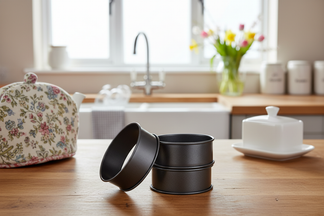
Crumpets are far more forgiving than they look, as long as the batter is the right consistency and the pan isn't too hot. You'll need rings — either the set of six crumpet rings for full-pan batches, or the made-in-England set of four. Then it's this.
How to make crumpets at home
- Make a loose batter: whisk flour, warm milk and water, yeast and a pinch of bicarbonate of soda into a smooth pourable batter. Leave it to rest and bubble for about an hour.
- Heat the pan to medium-low: a flat griddle or frying pan on a steady moderate heat. Too hot and the base burns long before the top sets.
- Oil the rings and the pan: a little oil brushed inside each ring and on the pan, so they release cleanly. Sit the rings on the pan to warm through.
- Fill each ring halfway: batter to about half the ring's depth, no more. It needs room to rise and bubble up.
- Cook until the holes set: 8–10 minutes, until bubbles have risen and burst across the top and the surface looks dry. Lift the ring away, and only flip it for a minute if you want the top lightly coloured.
If six is more than your hob needs, the Non-Stick Crumpet Rings Set of 4 (£17.99) is made in England with the same PFOA-free non-stick coating and the same 10-year guarantee, and those ones double as poachette rings for eggs.
The same rings hold English muffins, fried and poached-style eggs and small rosti, so they earn their drawer space well outside crumpet season. There are more uses than you'd think in our guide to using crumpet rings like a pro, and the rest of them live in the crumpet rings collection.
Which is healthier?
There is honestly not much in it. A crumpet is usually a little lower in calories than an English muffin, while the muffin tends to have slightly less fat and no cholesterol. So on paper the muffin edges it, but the gap is small enough not to lose sleep over.
In practice what goes on top matters far more than what's underneath. A scrape of fruit spread instead of butter, or a poached egg instead of melted cheese, changes the picture more than choosing between the two ever will.
Are crumpets good for you? In moderation, yes. They're a fairly light, low-fat base, and making either of these at home means you know exactly what's in them, which is the real advantage over a shop-bought pack.
So, which should you make?
Both are small, round, deeply British, and neither is the wrong answer.
Want crisp-bottomed, hole-topped and dripping with butter? Crumpets. Want something bready to split, toast and pile high? Muffins. The only honest way to settle it is to make a batch of each and decide for yourself, and a set of rings means you can do exactly that on the same pan. While you're in the mood, our guide to making your bakeware last 10 years is worth a read, and the whole range sits in all our bakeware.
Frequently asked questions
Are crumpets and English muffins the same?
No. They share a shape and a place on the breakfast table, but a crumpet is made from a loose batter, cooked on one side and served whole with a hole-filled top. An English muffin is made from a bread-like dough, cooked on both sides and split horizontally before eating.
Do I need crumpet rings to make crumpets?
Effectively, yes. Crumpet batter is loose and pourable, so without a ring it spreads into a thin pancake instead of rising into a tall, hole-topped crumpet. A ring holds the batter in shape on the pan until the top sets. Our crumpet rings come in a set of six so you can cook a full batch at once, or a made-in-England set of four.
Can I use crumpet rings for English muffins too?
Yes. Muffin dough holds its own shape, but a ring still gives you a tidier, more even round. The same rings also work for fried and poached-style eggs and small rosti, so they get used well beyond crumpets.
Why do crumpets have holes on top?
The yeast and bicarbonate of soda in the batter create bubbles as it cooks. Because a crumpet is cooked on one side only, those bubbles rise and burst at the top, leaving the open, hole-filled surface that soaks up butter. If the holes do not form, the batter is usually too thick or the pan is too hot.
How are crumpets different from bread?
Crumpets are made from a wet batter and cooked on a hob on one side, while bread is made from a kneaded dough and baked in the oven. That is why a crumpet is soft and hole-topped rather than firm-crusted all round.
Are crumpets healthier than English muffins?
There is very little between them. Crumpets are typically a little lower in calories, while English muffins tend to have slightly less fat and no cholesterol. The topping makes more difference than the choice of base — and making either at home lets you control exactly what goes in.
Are crumpets good for you?
In moderation, yes. A crumpet is a fairly light, low-fat base, so it's a reasonable choice — what you put on top matters most. A scrape of fruit spread keeps it lighter than butter and cheese. Made at home, you control the ingredients entirely.
Are Wrenbury crumpet rings dishwasher safe?
Yes, they are dishwasher safe, though hand washing and drying them promptly keeps the non-stick coating and the carbon steel in better shape for longer. A light brush of oil after washing helps if you bake less often. All six are covered by our 10-year guarantee.